How to Remove Background Noise from Video in 2026
Clean an existing video or audio file without re-recording. Compare a browser preview, Premiere, DaVinci Resolve, and Audacity, and see what each method cannot fix.
A fan, a street, or a humming fridge can make a clear face unusable. You do not have to reshoot the video to find out whether the voice can be saved. Listen to a short section first, then clean the whole file only if the voice still sounds like the person who recorded it.
This guide shows how to remove background noise from video you already have, and how to remove background noise from audio when the file has no picture. It also separates that job from echo, long pauses, and a recording you have not made yet.
Key Takeaways
- Clean the file you have before you plan a reshoot. Judge a short section, not a stock demo.
- Steady hiss, hum, and fan noise are the sounds these tools handle. Traffic, an audience, and room echo need a different choice.
- iPhone Voice Isolation changes the microphone while you record. It does not repair a video that is already saved.
- In Premiere, Enhance Speech can turn a stereo dialogue clip into a mono mix. In DaVinci Resolve, Voice Isolation is a Studio feature.
Match the noise to the tool
The right control depends on the sound, not on the app you already have open. A steady hiss behind one voice is a different problem from a ringing kitchen or a song under the speech.
| What you hear | What to use | What to expect |
|---|---|---|
| Fan, hum, hiss, or street wash under one voice in a video | A browser cleanup or the dialogue tool in your editor | The voice stays; some room tone can remain |
| The same steady noise in an audio-only file | Audacity's Noise Reduction, or a browser cleanup | A noise-only sample makes the manual method more predictable |
| The room rings or the voice sounds far away | An echo or reverb control, not a noise gate | Noise reduction will not pull the voice closer |
| Long silent gaps | A silence cut | This does not remove the noise inside the speech |
| The next iPhone recording, not an old file | Voice Isolation while recording | It cannot rewrite a clip you already exported |
Audacity's manual says Noise Reduction can reduce constant sounds such as hum, whistle, buzz, hiss, tape hiss, or fan noise. It also says the effect is not suitable for clicks and pops, or for irregular noise such as traffic or an audience. If the noise is very loud, keeps changing, or sits in the same frequencies as the voice, a satisfactory removal may be impossible. That limit applies to the other tools here too. (Audacity Manual: Noise Reduction, retrieved 2026-10-14.)
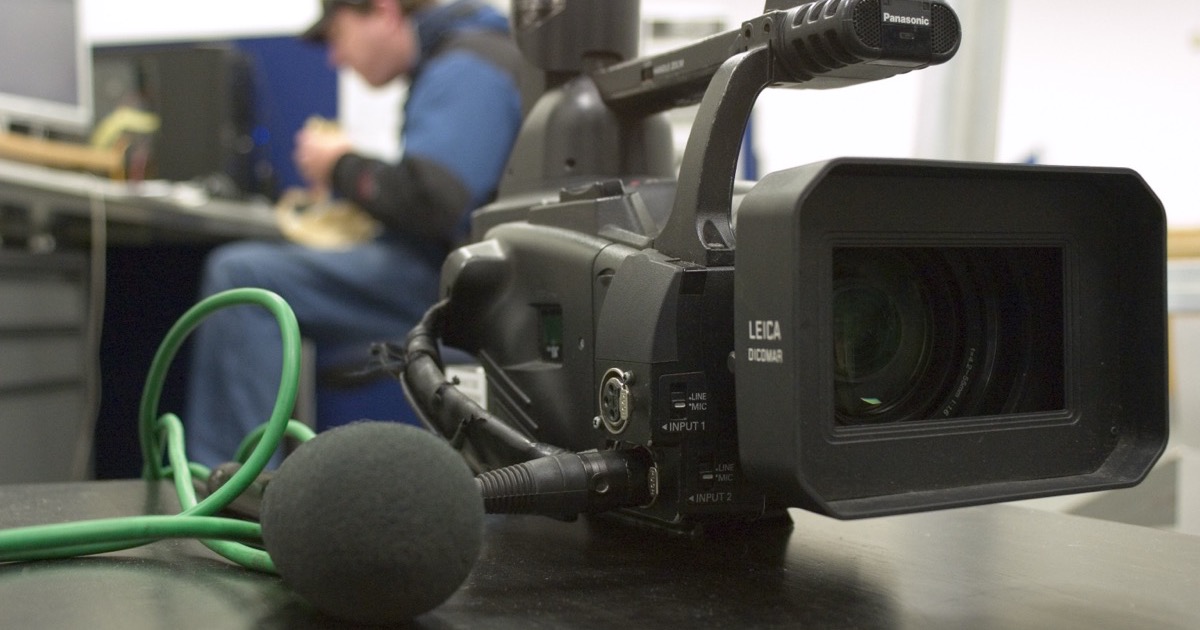
Photo: Panelxf, CC0, via Wikimedia Commons.

How to remove background noise from video in the browser
By the end of this step you will know whether the voice in your current file is worth cleaning. Use this when you have an MP4, MOV, M4V, or WebM and you do not want to install an editor.
- Open the video noise remover. An audio-only file can start on the audio and video cleanup page instead.
- Upload a file under 30 minutes and 500 MB. Audio files can be MP3, WAV, M4A, AAC, OGG, Opus, or FLAC.
- Sign in and play the first 30 seconds against the original. The preview is free, up to 20 previews for each account in a rolling 24 hours.
- Process the full file only if the cleaned voice is easier to follow than the original. A cleaned video downloads as MP4. A cleaned audio file downloads as WAV.
- Stop if the voice turns thin, metallic, or hollow. Keeping a little noise is better than saving a voice that no longer sounds human.
Uploads and finished files are deleted automatically 24 hours after upload. The preview does not use processing minutes. A full file is billed in whole minutes, rounded up, and a failed full job returns those minutes. The 1 Hour Pack is $2.99 for 60 minutes that do not expire. The 5 Hour Pack is $9.99 for 300 minutes. Pro is $9.99 per month, or $95.88 per year, with 20 hours in each billing period. Check the pricing page before you buy, because prices can change.
If the room itself is the problem, use echo removal. If you only need the dead air cut out, use silence removal. That silence tool runs in the browser, the file does not have to be uploaded, and it is free. It does not remove the fan behind the words.
Preview the first 30 seconds of my video
How to remove background noise from video in Premiere
By the end of this step, one dialogue clip will have an Enhance Speech pass you can compare with the untreated audio. Adobe's help page, last updated on January 7, 2026, says Enhance Speech reduces background noise and makes spoken audio more distinct.
- Put the clip on a timeline and select the audio that contains the dialogue.
- Open the Essential Sound panel and select Enhance. Premiere analyzes the clip in the background, so you can keep editing while it runs.
- Move the Mix Amount slider until you can hear both the cleaned voice and a little of the original room. All enhanced is not automatically better.
- Play the same sentence before and after. Listen for words that pump, lisp, or sound compressed.
Adobe's technical requirements add two limits. Enhance Speech supports only mono and stereo, not multichannel audio or nested sequences. A stereo clip comes back as a mono downmix. Enhance the dialogue track, not a finished mix that also contains music or other microphones. (Enhance Speech and its technical requirements, retrieved 2026-10-14.)
How to remove background noise from video in DaVinci Resolve
By the end of this step you will know whether your installed Resolve can isolate the voice on one clip or on a whole track.
Blackmagic's Fairlight Audio Post guide for DaVinci Resolve 18 calls Voice Isolation a Neural Engine effect that separates a human voice from background sounds. The lesson title says "Studio Version Only." Enable it on the selected clip from the Inspector. Enable it in the mixer only when every clip on that dialogue track should change. A newer release can move the button. Confirm the Studio edition before you rebuild a timeline around it. (DaVinci Resolve 18 Fairlight Audio Post guide, PDF, retrieved 2026-10-14.)
- Open the Fairlight page and play the noisy dialogue once.
- Select the clip and enable Voice Isolation in the Inspector. Use the mixer only for a whole track of the same noise.
- Play the same line. The lesson's examples are a fan and power-line hum.
- If the control is missing, check that the install is DaVinci Resolve Studio.
How to remove background noise from audio in Audacity
By the end of this step, Audacity will have learned a sample of the steady noise and applied a restrained reduction to the rest of the track. Use this for an audio file, or for a video after you have exported its soundtrack.

Photo: joncutrer, CC BY 2.0.
The current manual opens the effect from Effect > Noise Removal and Repair > Noise Reduction.
- Select a region that contains only the noise. Audacity needs at least 0.05 seconds at 44,100 Hz, and a longer sample is better. Do not copy a tiny sample over and over. The effect measures the noise. Repeating the same block does not improve the measurement.
- Choose Effect > Noise Removal and Repair > Noise Reduction, then click Get Noise Profile. The profile is forgotten when you quit Audacity.
- Select the part of the track you want to clean. Open Noise Reduction again. Start near the manual's defaults: Noise Reduction at 6 dB and Sensitivity at 6.00.
- Use Preview, and also listen to Residue. Residue is the sound that will be removed. If you hear the voice in that residue, lower Sensitivity or lower Noise Reduction.
- Select Reduce, then apply it. If different sections contain different noises, profile and reduce the first type before you profile the next one.
For a strong voice with light noise, try Frequency Smoothing at 0. If short random tones remain, try 1 to 6 bands. The manual says lower smoothing tends to favor music and higher smoothing tends to favor speech. Do click removal before noise reduction, and compression after it. A profile from one sample rate cannot clean a track at another rate.
Some distortion is normal. The effect works best when the voice is much louder than a little steady noise. Loud or changing noise can distort the voice enough that you should undo it. (Audacity Manual: Noise Reduction, retrieved 2026-10-14.)
Make the next iPhone recording cleaner
This step does not fix the video on your camera roll. Apple's support article says Voice Isolation prioritizes your voice and blocks ambient noise while a call or recording is happening.
During the recording, open Control Center, tap the app's controls, and under Audio & Video choose Voice Isolation. That choice stays with the app until you change it. Standard is ordinary processing, Wide Spectrum leaves the room in, and Automatic picks a mode.
Voice Isolation on a FaceTime call, or in certain third-party apps, needs iOS 15 or later. Inside a recording app such as Voice Memos, it needs iOS 26 or later. A phone call needs iOS 16.4 or later, and phone calls do not offer Wide Spectrum. Supported phones start with iPhone XR and iPhone XS. (Apple Support: Voice Isolation, retrieved 2026-10-14.)
If the bad take is already saved, go back to the browser, Premiere, or Resolve sections. Voice Isolation cannot reach into an exported file.
A 2025 CapCut walkthrough shows one phone-editor path for a video that is already saved: How to REMOVE BACKGROUND NOISE from a VIDEO (FREE CapCut) 2025. CapCut's control name differs between its phone, desktop, and web editors, so follow the noise-reduction label in the version you opened. Compare a sentence before you export.
Mistakes that make the voice worse
Turning the control all the way up. The noise gets quieter, and the consonants start to chirp or the voice sounds underwater. Use the smallest amount that makes the words easier to hear. Audacity tells you to do the same with its decibel slider.
Profiling speech instead of noise. Audacity needs a region with only the unwanted sound. A profile taken over words will treat the voice as something to remove.
Using noise reduction on echo. A ringing room is not a steady hiss. Send that file through echo removal, or use your editor's reverb tool. Cutting pauses with the silence tool also leaves the noise under the words untouched.
Enhancing a mixed stereo clip in Premiere. Music, a second speaker, and the dialogue can collapse into one mono result. Enhance the dialogue track, not a finished mix.
Assuming every Resolve install has Voice Isolation. The Fairlight lesson is marked Studio only. Check the edition before you promise a client that the button will be there.
What a usable result sounds like
Play one sentence with the effect off, then the same sentence with it on. The words should be easier to follow. A little room can remain. You should still recognize the speaker.
Reject the result if quiet syllables disappear, if the voice lisps, or if you hear short random tones where the noise used to be. Audacity calls those tones musical noise, bird song, or tinkly bells. They can be more distracting than the original hiss.
A cleaned EraseNoise video comes back as MP4, with the picture unchanged and the soundtrack replaced. A cleaned audio file comes back as WAV, not as the original MP3 or M4A. Neither result separates a song into vocals and music, and neither one repairs clipping or a microphone that distorted while recording.
Frequently asked questions
Can I remove background noise from a video I already shot?
Yes, when the noise is mostly steady and the voice is louder than that noise. Upload the video to the video noise remover, or use Enhance Speech in Premiere or Voice Isolation in DaVinci Resolve Studio. Listen to a short section before you process or export the whole file.
Does Voice Isolation on iPhone fix an old video?
No. Apple's Voice Isolation setting changes the microphone mode during a call or recording. Cleaning a saved video is a later edit. Recording apps need iOS 26 or later for Voice Isolation. Call and FaceTime support starts with older systems, as listed in Apple's article.
Will noise removal also remove echo, music, or silence?
No. Steady noise behind speech is the job on this page. Room echo belongs on the echo page. Long gaps belong on the silence page, which runs locally and is free. A backing track or vocal separation needs a different product.
Which file do I get back, and is the full download free?
Video comes back as MP4 and audio comes back as WAV, with the same 30-minute and 500 MB limits described above. The 30-second preview is free. The full file uses minutes. See pricing for the current packs and Pro plan.
Clean one real sentence first
You now have four ways to remove background noise from video or audio: a 30-second browser preview, Premiere's Enhance Speech, Resolve Studio's Voice Isolation, and Audacity's two-step Noise Reduction. The useful test is the same in each one. If the sentence is clearer and the speaker still sounds like themselves, keep it. If the voice breaks, undo it.